
Amaravati, the planned capital city of Andhra Pradesh, has secured a significant financial boost with ₹26,000 crore in funding, a government official has said.
The substantial investment is backed by the Department of Economic Affairs and the Ministry of Housing and Urban Affairs (MoHUA), along with partnerships with multilateral agencies such as the World Bank and the Asian Development Bank (ADB). The funds will be channelled into large-scale infrastructure projects and governance reforms aimed at modernising the city. A major portion of this funding includes ₹11,000 crore in soft loans from the World Bank and the Asian Development Bank (ADB).
“In the past few weeks alone, contracts worth ₹40,000 crore have been awarded, further strengthening Amravati’s development momentum,” said G Surya Sai Praveenchand, Additional Commissioner, Capital Region Development Authority, Government of Andhra Pradesh, during a discussion at the CII South India Annual Convention 2025.
“Discussions with the World Bank and ADB are underway to establish an integrated governance framework that streamlines city and district administration for efficient urban management,” he added.
Located between Vijayawada and Guntur, Amaravati benefits from its proximity to key economic hubs. The region is already a centre for logistics, food processing, and industrial activities, with specific zones such as Guntur’s logistics hub, Vijayawada’s food processing industry, and Nandigama’s emerging pharmaceutical sector. “Amaravati itself is set to focus on non-polluting industries, ensuring sustainable economic growth,” he added.
The city has also planned a future-ready infrastructure initiative: a 24/7 “Drink from the Tap” facility along with 100 per cent wastewater reuse. To achieve this, the government is ensuring the treatment of wastewater by implementing a dual-pipeline system—one for supplying drinking water for both domestic and industrial use and a parallel pipeline for reused water. Amaravati is also developing a piped gas supply system to serve every resident in the city.
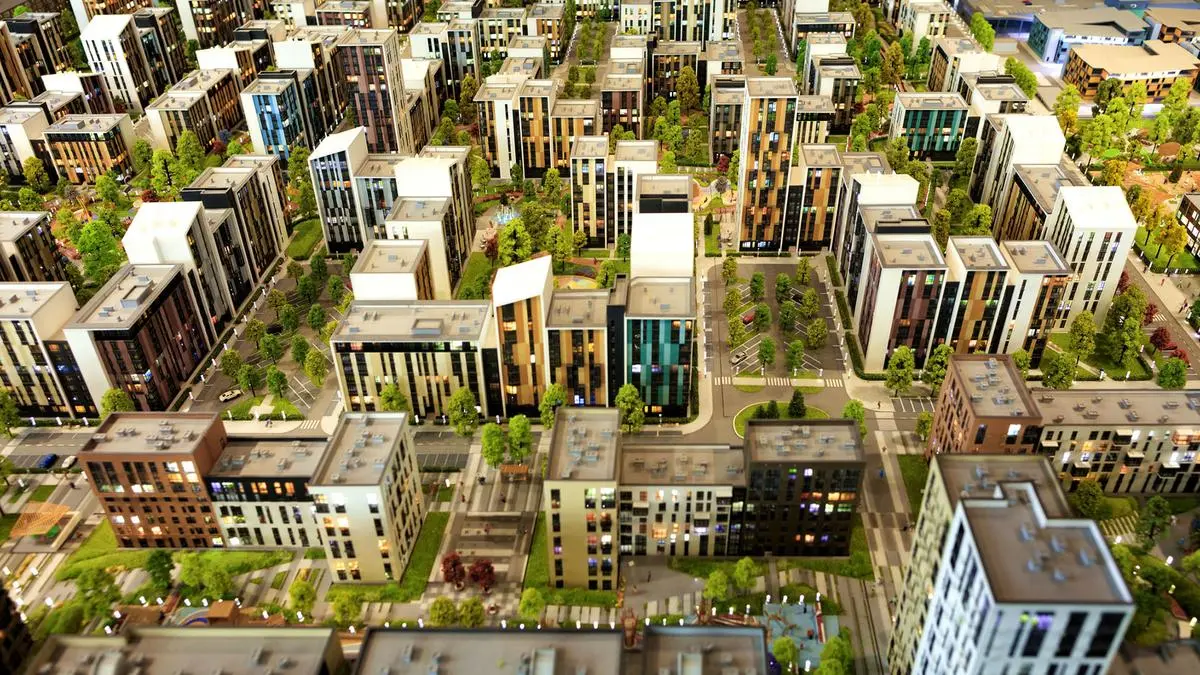
Designed in collaboration with Singapore-based urban planners, Amaravati will consist of 27 townships and 108 neighbourhoods, structured around the 5-10-15 principle—ensuring five-minute access to emergency services, ten-minute proximity to open spaces, and a 15-minute commute to workplaces.
A key driver of Amravati’s development has been its innovative land pooling model, where 30,000 farmers voluntarily contributed 34,700 acres of land. Rather than receiving a one-time compensation, they were made stakeholders in the city’s growth, receiving 30 per cent of their original land as developed plots, providing them with long-term economic benefits.
The city also plans green infrastructure, featuring 2,000 km of shaded pedestrian pathways and dedicated cycling lanes to promote non-motorised transportation. Moreover, 30 per cent of the city—covering nearly 65 km²—is designated for green and blue spaces, including urban forests, parks, and a 48 km-long canal network to enhance ecological sustainability.
Following the bifurcation of Andhra Pradesh, Amaravati was planned as a city for 3.5 million people, covering an area of 275 square km along the Krishna River.